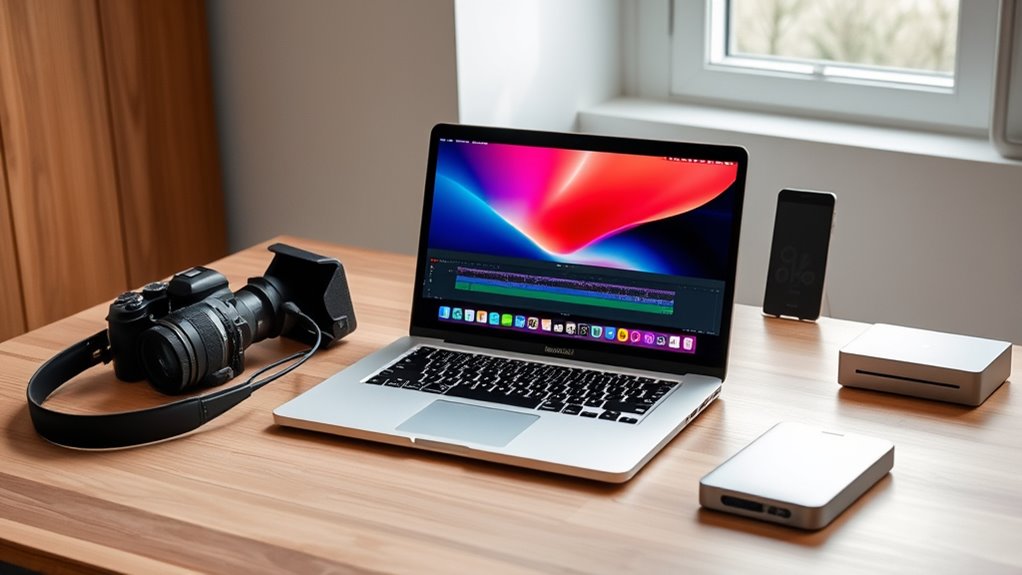

For most video editors, I’d choose the 16-inch MacBook Pro with M5 Pro and 48GB memory as the best overall balance of screen space, editing headroom, and portability. The 14-inch M5 Pro with 24GB memory is a more compact choice for editors who travel, while the 14-inch M5 Max with 64GB memory suits demanding effects and high-resolution workflows. The main tradeoffs are screen size versus portability, memory and graphics capacity versus everyday needs, and newer chips versus the uncertainty of renewed older models. This roundup compares those differences across all 10 listed configurations. Read on for the full breakdown and guidance on choosing the right MacBook Pro for video editing.

Get oils, diffusers and self-care delivered free with Prime
- Fast, free delivery on millions of items
- Prime Video, Amazon Music and more included
- Member-only deals all year
Key Takeaways
- The 16-inch M5 Pro with 48GB memory is the strongest all-around fit in this lineup for editors who want more workspace and memory headroom without choosing the M5 Max tier.
- The 14-inch M5 Max with 64GB memory and 2TB SSD is the performance-focused pick, but its capacity is more than many basic or occasional editing workflows need.
- The two 14-inch M5 Pro configurations share a processor class but differ in memory, making the 48GB model more suitable for heavier projects and multitasking.
- The 14-inch M5 models with 24GB memory offer a sensible middle ground for general editing; the 16GB configuration leaves less room for demanding timelines and background apps.
- The renewed M4 Max, M1 Pro, and Intel models vary widely in age and capability, so buyers should weigh the specific chip and memory against renewed-condition uncertainty rather than treating them as equivalent alternatives.




| macbook pro for video editing | Display | Memory | Storage | Ports |
|---|---|---|---|---|
| Apple 2024 MacBook Pro 16-inch | 16-inch Liquid Retina XDR | 48GB unified memory | 1TB SSD | — |
| Apple MacBook Pro 16.2-inch wi | 16.2-inch Liquid Retina XDR | 24GB unified memory | 1TB SSD | Three Thunderbolt 5, MagSafe 3, SDXC card slot, HDMI, headphone jack |
| Apple MacBook Pro | 14.2-inch Liquid Retina XDR; 1600 nits peak brightness, 1000 nits sustained brightness, 1,000,000:1 contrast | 24GB unified memory | 1TB SSD | Three Thunderbolt 5, MagSafe 3, SDXC card slot, HDMI, headphone jack |
| Apple 2020 MacBook Pro 13-inch | 13.3-inch Retina, 2560 x 1600 | 16GB RAM | 512GB SSD | — |
| Apple 14.2-inch MacBook Pro | 14.2-inch Liquid Retina XDR; 1600 nits peak brightness, up to 1000 nits sustained brightness, 1,000,000:1 contrast | 24GB unified memory | 1TB SSD | Three Thunderbolt 4, MagSafe 3, SDXC card slot, HDMI, headphone jack |
| Apple MacBook Pro 16-inch | 16.2-inch Liquid Retina XDR, 3456 × 2234, 120Hz ProMotion | 32GB unified RAM | 512GB SSD | — |
| Apple 16.2-inch MacBook Pro wi | 16.2-inch Liquid Retina XDR | 48GB unified memory | 1TB SSD | Three Thunderbolt 5, MagSafe 3, SDXC, HDMI, headphone jack |
| Apple 14.2-inch MacBook Pro | 14.2-inch Liquid Retina XDR | 24GB unified memory | 1TB SSD | Three Thunderbolt 4, MagSafe 3, SDXC card slot, HDMI, headphone jack |
| Apple MacBook Pro 14.2-inch wi | 14.2-inch Liquid Retina XDR | 64GB unified memory | 2TB SSD | Three Thunderbolt 5, MagSafe 3, SDXC card slot, HDMI, headphone jack |
| Apple 14.2-inch MacBook Pro wi | 14.2-inch Liquid Retina XDR | 16GB unified memory | 1TB SSD | Three Thunderbolt 4, MagSafe 3, SDXC card slot, HDMI, headphone jack |
More Details on Our Top Picks
Apple 2024 MacBook Pro 16-inch with M4 Max Chip, 48GB RAM, 1TB SSD, Space Black (Renewed)
I’d rank this renewed 16-inch M4 Max for editors whose timelines lean on GPU effects, demanding color work, or high-resolution footage. Its M4 Max chip and 48GB of unified memory give it more headroom for complex projects than the 24GB M5 Pro models in this roundup, while the 16-inch Liquid Retina XDR display offers more room for editing panels and reviewing detail. The SDXC slot and HDMI also make common editing connections easier without relying on as many adapters. The tradeoff is its renewed condition: battery wear, cosmetic marks, or warranty limits may matter more on a machine intended for daily professional use. Compared with the newer 16-inch M5 Pro, this pick favors memory capacity and a Max-tier chip over a newer-generation platform.
Pros:- M4 Max chip suits demanding GPU-accelerated editing tasks
- 48GB unified memory provides more headroom for complex timelines than the 24GB models listed
- 16-inch Liquid Retina XDR display gives more workspace for editing and review
- HDMI and SDXC slot simplify connections to displays and camera media
Cons:- Renewed condition can mean cosmetic wear, battery variability, or limited warranty coverage
- Larger chassis is less convenient to carry than the 14-inch M5 Pro and M5 models
- 1TB SSD may fill quickly with high-resolution footage and active project files
Best for: Video editors handling GPU-intensive effects, color grading, or large projects who want 48GB memory and a large built-in display.
Not ideal for: Buyers who require a new machine with predictable condition and warranty coverage, or editors whose work is mostly light cutting and exports.
- Chip:Apple M4 Max
- Display:16-inch Liquid Retina XDR
- Memory:48GB unified memory
- Storage:1TB SSD
- Color:Space Black
- Keyboard:QWERTY English Magic Keyboard with Touch ID
- Connectivity:MagSafe, HDMI, SDXC card slot, Thunderbolt ports
Our verdict“Choose this renewed M4 Max if GPU-heavy editing and 48GB of memory matter more than a new-device condition guarantee.”
Apple MacBook Pro 16.2-inch with M5 Pro, 18-core CPU, 20-core GPU, 24GB Memory, 1TB SSD, Wi-Fi 7 – Space Black
This 16.2-inch M5 Pro is my pick for editors who want a large working display in a newer MacBook Pro configuration without stepping up to the renewed M4 Max. The 18-core CPU and 20-core GPU are aimed at demanding creative work, and the Liquid Retina XDR screen gives footage and editing controls generous space. Compared with the 14.2-inch M5 Pro, the larger panel better suits extended timeline work, though the smaller model is easier to carry. Three Thunderbolt 5 ports, HDMI, and SDXC reduce friction when connecting drives, monitors, and camera cards. Its main compromise is 24GB of memory: editors working with especially complex effects or multiple large projects may prefer the M4 Max model’s 48GB, while buyers seeking compact portability should look at the 14-inch options.
Pros:- 18-core CPU and 20-core GPU target demanding creative workflows
- 16.2-inch Liquid Retina XDR display provides more space for timelines and panels
- Three Thunderbolt 5 ports, HDMI, and SDXC support broad editing setups
- Wi-Fi 7 and a 12MP Center Stage camera support modern connectivity and video calls
Cons:- 24GB unified memory offers less headroom than the 48GB M4 Max model in this roundup
- 16.2-inch size is less portable than either 14-inch MacBook Pro option
- No listed memory expansion means buyers need to choose capacity carefully
Best for: Editors who work for long stretches at a desk or on location and want a large XDR display, current Pro-class processing, and built-in media ports.
Not ideal for: Editors who regularly keep very large projects and many demanding apps open at once, or frequent travelers who prioritize a smaller laptop.
- Processor:Apple M5 Pro, 18-core CPU
- Graphics:20-core GPU
- Display:16.2-inch Liquid Retina XDR
- Memory:24GB unified memory
- Storage:1TB SSD
- Wireless:Wi-Fi 7, Bluetooth 6
- Camera:12MP Center Stage
- Ports:Three Thunderbolt 5, MagSafe 3, SDXC card slot, HDMI, headphone jack
Our verdict“Pick this model for a large-screen editing setup with M5 Pro performance, but choose the M4 Max if your projects need more memory headroom.”
Apple MacBook Pro (14.2-inch, M5 Pro, 24GB Unified Memory, 1TB SSD) – Space Black
I’d choose this 14.2-inch M5 Pro when editing performance needs to travel with me. It pairs a 15-core CPU and 16-core GPU with 24GB of unified memory, placing it above the standard M5 14-inch model for demanding creative work while keeping a smaller footprint than the 16.2-inch M5 Pro. The Liquid Retina XDR display, SDXC slot, HDMI, and three Thunderbolt 5 ports make it a capable field-editing setup rather than a thin laptop that depends on adapters. Its limit is the combination of a compact screen and 24GB memory: large timelines feel tighter, and heavy projects have less memory headroom than the 48GB renewed M4 Max. I’d skip it if a built-in large canvas or maximum capacity matters more than portability.
Pros:- M5 Pro chip offers a stronger creative-work focus than the standard M5 14-inch model
- 14.2-inch size is easier to carry than the 16.2-inch M5 Pro
- XDR display and SDXC slot are useful for reviewing footage and importing camera media
- Three Thunderbolt 5 ports plus HDMI support a capable desk or field setup
Cons:- 24GB memory is below the 48GB capacity of the renewed M4 Max
- Smaller screen gives less room for timelines and editing panels than either 16-inch model
- 1TB storage may require external media storage for extensive footage libraries
Best for: Traveling editors and camera operators who need a compact MacBook Pro for on-location cuts, review, and moderate-to-demanding project work.
Not ideal for: Editors who need a large built-in timeline workspace or regularly run memory-heavy effects and multiple large projects.
- Chip:Apple M5 Pro
- CPU:15-core
- GPU:16-core
- Memory:24GB unified memory
- Storage:1TB SSD
- Display:14.2-inch Liquid Retina XDR; 1600 nits peak brightness, 1000 nits sustained brightness, 1,000,000:1 contrast
- Wireless:Wi-Fi 7, Bluetooth 6
- Ports:Three Thunderbolt 5, MagSafe 3, SDXC card slot, HDMI, headphone jack
Our verdict“Choose this 14-inch M5 Pro for portable editing with Pro-tier hardware, and step up to a 16-inch model for more screen or memory headroom.”
Apple 2020 MacBook Pro 13-inch, Intel Core i5 2.0GHz, 16GB RAM, 512GB SSD, Space Gray (Renewed)
This renewed 2020 Intel MacBook Pro is the entry point here for buyers whose editing needs are modest and whose software requirements favor an older Intel Mac. Its 16GB of RAM and 512GB SSD can support basic cuts, short clips, and lighter projects, while the 13.3-inch Retina display keeps the machine compact. It is a very different proposition from the M5 Pro and M4 Max models above: integrated graphics and an older Core i5 platform make it less suited to sustained effects work, demanding codecs, or fast export-heavy schedules. The smaller display also leaves less room for a timeline. I’d only choose it if the project workload is simple and the renewed condition is acceptable; for regular professional editing, the newer Apple-silicon options are a much safer fit.
Pros:- Compact 13.3-inch Retina display suits basic editing away from a desk
- 16GB RAM is more capable for light multitasking than an entry-level memory configuration
- 512GB SSD provides local space for smaller projects and applications
- Renewed product is professionally inspected and eligible for the stated Renewed Guarantee
Cons:- Older Intel Core i5 and integrated graphics are less suited to demanding video-editing workloads than the M-series options
- 13.3-inch screen limits timeline and panel workspace compared with the 14-inch and 16-inch models
- Renewed condition can involve prior use and potential cosmetic wear
Best for: Students or hobbyist editors working on short, straightforward projects who specifically need an Intel-based Mac and accept renewed-device condition.
Not ideal for: Professional editors, users working with complex effects or high-resolution footage, and buyers who need current-generation performance or a large editing display.
- Model year:2020
- Display:13.3-inch Retina, 2560 x 1600
- Processor:2.0GHz Intel Core i5
- Memory:16GB RAM
- Storage:512GB SSD
- Graphics:Integrated graphics
- Weight:3.1 pounds
- Battery life:Up to 10 hours
Our verdict“Choose this renewed Intel model only for basic editing and legacy software needs; frequent or demanding editors should pick an Apple-silicon MacBook Pro.”
Apple 14.2-inch MacBook Pro (2025) with M5 chip, 24GB memory, 1TB SSD, Silver
This 14.2-inch M5 is the balanced pick for editors whose work is frequent but not consistently GPU-heavy. Its 10-core CPU, 10-core GPU, and 24GB of unified memory provide a modern foundation for editing, while the 1TB SSD offers more working room than the 512GB drive in the renewed Intel model. The Liquid Retina XDR display and SDXC slot are practical for footage review and direct camera-card imports. Compared with the 14-inch M5 Pro, this standard M5 model has a less powerful CPU and GPU and Thunderbolt 4 rather than Thunderbolt 5, so it is the more restrained choice for intensive effects or demanding workflows. It still makes more sense than the old Intel option for buyers wanting a current 14-inch machine, but heavy editors should step up to M5 Pro.
Pros:- 24GB unified memory supports more multitasking headroom than the 16GB renewed Intel model
- 1TB SSD offers ample onboard room for apps and active projects
- Liquid Retina XDR display provides a bright, high-contrast editing view
- SDXC, HDMI, and three Thunderbolt 4 ports support common editing connections
Cons:- 10-core GPU is a step below the M5 Pro models for graphics-intensive editing
- Thunderbolt 4 is less advanced than the Thunderbolt 5 ports on both M5 Pro options
- 14.2-inch screen provides less workspace than the 16-inch models
Best for: Freelancers, students, and content creators who edit regularly but mostly work with straightforward timelines and want a current 14-inch MacBook Pro.
Not ideal for: Editors who rely on intensive GPU effects, complex multicamera timelines, or high-bandwidth Thunderbolt 5 workflows.
- Chip:Apple M5
- CPU:10-core
- GPU:10-core
- Display:14.2-inch Liquid Retina XDR; 1600 nits peak brightness, up to 1000 nits sustained brightness, 1,000,000:1 contrast
- Memory:24GB unified memory
- Storage:1TB SSD
- Ports:Three Thunderbolt 4, MagSafe 3, SDXC card slot, HDMI, headphone jack
- External display support:Up to two displays
Our verdict“Pick the standard M5 14-inch for everyday editing and broad connectivity, but move to M5 Pro if your work regularly pushes GPU performance.”
Apple MacBook Pro 16-inch (2021) with M1 Pro, 32GB RAM, 512GB SSD, Space Gray (Renewed)
I’d pick this renewed 16-inch model for editors who want a roomy timeline and substantial memory without needing the newest chip generation. Its 10-core M1 Pro and 32GB unified memory suit multicam work and demanding projects better than the 16GB M5 configuration, while the 120Hz Liquid Retina XDR display gives motion and interface movement a smooth feel. Compared with the newer 16.2-inch M5 Pro model, it gives up processing headroom, newer connectivity and more built-in storage; its 512GB drive can fill quickly with source footage and cache files. The main compromise is its renewed condition, which may not appeal to buyers seeking a new machine. I’d choose it for a big-screen editing setup where memory matters more than having the latest generation.
Pros:- 32GB unified memory supports heavier editing timelines and multitasking
- 16.2-inch Liquid Retina XDR display provides generous workspace
- 120Hz ProMotion refresh rate makes motion and scrolling appear smoother
- 1080p camera and six-speaker system support calls and media playback
Cons:- Renewed condition may not suit buyers who want a new laptop
- 512GB SSD leaves limited room for large footage libraries and project caches
- M1 Pro is an older generation than the M5 and M5 Pro options in this roundup
Best for: Editors who want a large built-in display and 32GB of memory for demanding timelines, and are comfortable buying a renewed laptop.
Not ideal for: Buyers who need a new device, ample internal space for large media libraries, or the processing and connectivity of the newer M5 Pro models.
- Model:MacBook Pro (2021)
- Processor:Apple M1 Pro, 10-core CPU
- Graphics:16-core GPU
- Memory:32GB unified RAM
- Storage:512GB SSD
- Display:16.2-inch Liquid Retina XDR, 3456 × 2234, 120Hz ProMotion
- Battery life:Up to 20–21 hours, depending on workload
- Condition:Renewed
Our verdict“Choose this renewed 16-inch MacBook Pro if you prioritize a large screen and 32GB of memory over new-device condition and newer-generation performance.”
Apple 16.2-inch MacBook Pro with M5 Pro, 18-core CPU, 20-core GPU, 48GB Memory, and 1TB SSD
This is my strongest fit among these five for editors who want a large screen and substantial headroom for complex projects. The M5 Pro with an 18-core CPU and 20-core GPU, paired with 48GB of memory, is better suited to layered timelines and heavy multitasking than the M5-based 14-inch models here. Its 1TB SSD also gives projects more breathing room than the renewed M1 Pro’s 512GB drive, though a media-heavy workflow may still call for external storage. The three Thunderbolt 5 ports, HDMI and SDXC slot make connecting drives, cards and displays less dependent on adapters; it supports up to three external displays. The tradeoff is portability: at 4.71 pounds, it is heavier than the 14-inch options. The stated battery description lacks a runtime figure, too.
Pros:- M5 Pro with 18-core CPU and 20-core GPU targets demanding creative workloads
- 48GB unified memory offers headroom for complex timelines and concurrent apps
- 1TB SSD provides more working space than the renewed M1 Pro’s 512GB drive
- Thunderbolt 5, HDMI, SDXC, and support for up to three external displays simplify studio connections
Cons:- At 4.71 pounds, it is heavier than the 14-inch MacBook Pro options
- Battery life is described as all-day without a specific runtime in the product data
- The 1TB internal drive may still be insufficient for large footage archives
Best for: Editors working on layered, demanding projects who want a large screen, substantial memory, and direct connections for cards, drives, and multiple displays.
Not ideal for: Frequent travelers and mobile editors who value a lighter laptop, or buyers who need a clearly stated battery-runtime figure.
- Processor:Apple M5 Pro, 18-core CPU
- Graphics:20-core GPU
- Memory:48GB unified memory
- Storage:1TB SSD
- Display:16.2-inch Liquid Retina XDR
- Ports:Three Thunderbolt 5, MagSafe 3, SDXC, HDMI, headphone jack
- External display support:Up to three displays
- Weight:4.71 pounds
Our verdict“Pick this 16-inch M5 Pro when demanding edits, a large workspace, and broad connectivity matter more than a light carry weight.”
Apple 14.2-inch MacBook Pro (2025) with M5 chip, 10-core CPU, 10-core GPU, 24GB memory, 1TB SSD, Space Black
I’d choose this 14-inch M5 configuration for editors who move between locations but still want more working memory than the 16GB M5 model provides. Its 24GB unified memory gives demanding creative apps more room, while the 1TB SSD is a practical step up from the 512GB storage in the renewed 16-inch M1 Pro. The compact chassis is easier to carry than the 16-inch M5 Pro, and its Liquid Retina XDR screen, SDXC slot and HDMI port make it a capable mobile edit station. The tradeoff is graphics capacity: its 10-core GPU is a less ambitious fit for effects-heavy work than the 20-core GPU in the 16-inch M5 Pro or the M5 Max option. It also supports up to two external displays, fewer than the M5 Pro and M5 Max models listed here.
Pros:- 24GB unified memory gives creative workloads more headroom than the 16GB M5 configuration
- 1TB SSD offers useful capacity for active projects
- 14.2-inch size is more portable than the 16-inch MacBook Pro options
- SDXC, HDMI, and three Thunderbolt 4 ports support common editing peripherals
Cons:- 10-core GPU is less suited to graphics-intensive work than the M5 Pro and M5 Max configurations
- Supports up to two external displays, fewer than the M5 Pro and M5 Max options
- Smaller screen provides less timeline workspace than the 16.2-inch models
Best for: Mobile editors who want a lighter 14-inch laptop, 24GB of memory, and enough internal storage for active projects.
Not ideal for: Editors handling GPU-heavy effects or multi-display studio setups who would benefit from the stronger graphics and broader external-display support of M5 Pro or M5 Max models.
- Chip:Apple M5
- CPU:10-core
- GPU:10-core
- Display:14.2-inch Liquid Retina XDR
- Memory:24GB unified memory
- Storage:1TB SSD
- Ports:Three Thunderbolt 4, MagSafe 3, SDXC card slot, HDMI, headphone jack
- External display support:Up to two displays
Our verdict“Choose this 14-inch M5 model if portability and 24GB of memory outweigh the larger screen and stronger GPU options in the lineup.”
Apple MacBook Pro 14.2-inch with M5 Max, 18-Core CPU, 40-Core GPU, 64GB Memory, 2TB SSD, Silver
For editors whose projects lean hard on effects, high-resolution media, or multiple external screens, this 14-inch configuration brings the most expansive hardware in this group. The 40-core M5 Max GPU and 64GB of unified memory provide more graphics and memory headroom than the 10-core GPU and 24GB memory in the compact M5 model. Its 2TB SSD also gives active media projects substantially more internal space than the other listed configurations. The 14.2-inch display keeps the machine more portable than the 16-inch M5 Pro, but that smaller panel offers less room for a timeline and preview window. It supports up to four external displays and includes Thunderbolt 5, HDMI and SDXC. This much capability may be unnecessary for straightforward cuts, and the product data gives no weight or battery-runtime figure for travel planning.
Pros:- 40-core GPU is the strongest listed graphics configuration in this five-product group
- 64GB unified memory supports demanding timelines and multitasking
- 2TB SSD provides more internal room for active footage and project files
- Supports up to four external displays and includes Thunderbolt 5, HDMI, and SDXC
Cons:- 14.2-inch display offers less editing workspace than the 16.2-inch MacBook Pro models
- Its high-end hardware may be unnecessary for basic editing workflows
- Product data does not specify weight or battery runtime
Best for: Professional editors handling GPU-intensive effects or large projects who need generous internal storage and a multi-display workstation.
Not ideal for: Editors doing straightforward cuts who do not need a 40-core GPU, 64GB of memory, or four external displays, and buyers who need a stated weight or battery runtime.
- Chip:Apple M5 Max
- CPU:18-core
- GPU:40-core
- Display:14.2-inch Liquid Retina XDR
- Memory:64GB unified memory
- Storage:2TB SSD
- Ports:Three Thunderbolt 5, MagSafe 3, SDXC card slot, HDMI, headphone jack
- External display support:Up to four displays
Our verdict“Choose the M5 Max 14-inch model for GPU-heavy editing and a multi-display setup, but skip it if your workflow does not use its added headroom.”
Apple 14.2-inch MacBook Pro with M5 chip, 16GB unified memory, and 1TB SSD, Space Black
This 14-inch M5 model makes the most sense for editors whose projects are relatively straightforward and who value a capable, portable machine more than extra memory. The 10-core CPU and 10-core GPU pair with a bright Liquid Retina XDR display, while the 1TB SSD gives active footage more room than the renewed M1 Pro’s 512GB drive. Its SDXC slot and HDMI port help connect common editing gear without relying entirely on adapters. Compared with the 24GB M5 model in this roundup, though, its 16GB unified memory leaves less headroom for large timelines, effects, and other apps running alongside an editor. Both 14-inch M5 configurations support up to two external displays. I’d reserve this option for lighter editing rather than sustained, memory-heavy work.
Pros:- M5 chip combines a 10-core CPU and 10-core GPU
- 1TB SSD offers room for more active footage than a 512GB configuration
- Liquid Retina XDR display has up to 1600 nits peak brightness
- HDMI and SDXC ports support common editing connections
Cons:- 16GB unified memory provides less headroom than the 24GB M5 option
- Supports up to two external displays
- 14.2-inch screen gives less timeline space than the 16.2-inch models
Best for: Newer editors and creators cutting short-form or less demanding footage who want a portable MacBook Pro with 1TB of storage.
Not ideal for: Editors working with large timelines, complex effects, or several demanding apps at once, who are better served by the 24GB M5 or higher-memory configurations.
- Processor:Apple M5 chip with 10-core CPU
- GPU:10-core GPU
- Memory:16GB unified memory
- Storage:1TB SSD
- Display:14.2-inch Liquid Retina XDR
- Display brightness:Up to 1600 nits peak; up to 1000 nits sustained
- Ports:Three Thunderbolt 4, MagSafe 3, SDXC card slot, HDMI, headphone jack
- External display support:Up to two displays
Our verdict“Pick this 16GB M5 model for lighter editing and everyday portability, but choose the 24GB version if your projects or multitasking are demanding.”

How We Picked
I ranked these MacBook Pro configurations by how well their listed chip, memory, storage, and screen size match real editing demands, from everyday 1080p and 4K timelines to effects-heavy projects and large media libraries. I gave more weight to configurations with useful memory headroom and capable graphics for sustained editing, while also accounting for portability and whether the built-in storage leaves room for active footage.
The ranking favors current M5 Pro and M5 Max models for their newer platform and clearer fit for demanding creative work, but it does not assume every editor needs the highest tier. Within similar chip families, I separate models by memory and screen size. Renewed options rank lower when their older hardware or condition uncertainty makes them harder to recommend as a primary editing machine, though the M4 Max and M1 Pro remain distinct possibilities for buyers with specific needs.
| macbook pro for video editing | Chip | Ports | External display support |
|---|---|---|---|
| Apple 2024 MacBook Pro 16-inch | Apple M4 Max | — | — |
| Apple MacBook Pro 16.2-inch wi | — | Three Thunderbolt 5, MagSafe 3, SDXC card slot, HDMI, headphone jack | — |
| Apple MacBook Pro | Apple M5 Pro | Three Thunderbolt 5, MagSafe 3, SDXC card slot, HDMI, headphone jack | — |
| Apple 2020 MacBook Pro 13-inch | — | — | — |
| Apple 14.2-inch MacBook Pro | Apple M5 | Three Thunderbolt 4, MagSafe 3, SDXC card slot, HDMI, headphone jack | Up to two displays |
| Apple MacBook Pro 16-inch | — | — | — |
| Apple 16.2-inch MacBook Pro wi | — | Three Thunderbolt 5, MagSafe 3, SDXC, HDMI, headphone jack | Up to three displays |
| Apple 14.2-inch MacBook Pro | Apple M5 | Three Thunderbolt 4, MagSafe 3, SDXC card slot, HDMI, headphone jack | Up to two displays |
| Apple MacBook Pro 14.2-inch wi | Apple M5 Max | Three Thunderbolt 5, MagSafe 3, SDXC card slot, HDMI, headphone jack | Up to four displays |
| Apple 14.2-inch MacBook Pro wi | — | Three Thunderbolt 4, MagSafe 3, SDXC card slot, HDMI, headphone jack | Up to two displays |
Factors to Consider When Choosing Macbook Pro For Video Editing
I’d choose a MacBook Pro for video editing by matching the machine to the footage, effects, and working habits I actually expect—not by buying the largest specification available. These broader tradeoffs can help narrow the field before comparing individual configurations.
Match the chip tier to your timeline
Editing simple cuts and color adjustments places different demands on a laptop than stacking effects, compositing, or working with high-resolution footage. A higher graphics tier can help with GPU-heavy tasks, but it does not make every export or timeline operation faster by the same amount. Identify the slowest part of your current workflow—playback, rendering, effects, or file handling—before paying for more chip capacity. Editors who work mainly with lighter projects may benefit more from extra memory or storage than a top-tier processor. If your workload changes often, leave room for growth, but avoid buying for an imagined future project that may never arrive.
Treat memory as editing headroom
Memory affects how comfortably an editor can keep a timeline, media, effects, and other applications active at once. Large projects and multitasking can make a configuration with more unified memory feel less constrained, even when two models use the same chip family. A common mistake is to prioritize processor branding while overlooking the memory difference between configurations. On a MacBook Pro, memory is not a casual later upgrade, so choosing too little can limit the useful life of the machine. For light editing, a middle configuration can be adequate; for complex timelines or long-term use, I’d favor more headroom.
Choose screen size around your work setup
A 16-inch display gives more room for a timeline, preview, and editing panels, which can reduce reliance on an external monitor. That extra workspace comes with a larger laptop that is less convenient to carry every day. A 14-inch model is easier to take between locations and can still anchor a desk setup with an external display. Buyers often focus on the screen diagonal without asking where most editing will happen. If you regularly edit away from a desk, portability may matter more than the additional built-in workspace; if the laptop is your main editing station, the larger panel can be worthwhile.
Plan storage around footage, not just applications
Video projects can consume storage quickly, especially when originals, proxies, exports, and backups sit on the same drive. A 1TB internal SSD may suit an editor who keeps active projects local and archives finished work externally, while a larger drive reduces the need to manage files as often. Do not assume the operating system and editing apps are the main storage demands: source media and cache files often take much more room. External SSDs can expand capacity, but they add cables and another item to manage on the move. Decide whether you value a cleaner portable setup or prefer keeping bulk footage on external storage.
Compare renewed models with care
A renewed MacBook Pro may offer an older high-tier chip or a larger display in a different configuration, but the label alone does not reveal battery condition, included accessories, or the terms of the seller’s return and warranty coverage. Check those details before comparing a renewed model with a current configuration. Older hardware can still fit a defined workflow, yet it may have less room for future software demands than a newer model. Be especially careful with Intel-era systems: their age makes them a different proposition from Apple silicon models, even when the memory and storage figures look familiar. I’d choose renewed only when the exact configuration and purchase protections make the tradeoff acceptable.
Spend for the bottleneck you can name
Higher-tier configurations make sense when they address a real limitation: insufficient memory, slow effects processing, or a need to work with demanding footage without proxies. They are harder to justify when editing consists mostly of straightforward cuts and occasional exports. Before moving up a tier, check whether project organization, proxy workflows, or external storage would solve the actual problem. A faster machine cannot compensate for a poorly managed media library or a workflow that already runs smoothly. I’d put extra capacity where it will change daily editing, then keep the remaining setup simple.
Frequently Asked Questions
Is the 16-inch M5 Pro with 24GB memory enough for video editing?
It can suit general editing, including many 4K projects, if the timeline and effects load are moderate. The larger display makes it easier to work directly on the laptop, while 24GB memory is less generous than the 48GB configuration in this roundup. If you routinely run several creative apps, use complex effects, or keep large timelines open, I’d favor the 48GB model for added headroom. For lighter work, the lower-memory configuration may be a more practical fit. Your footage, editing software, and multitasking habits matter more than the screen size alone.
Should I choose the 14-inch M5 Max or the 16-inch M5 Pro for demanding editing?
Choose based on what limits your work most: graphics-heavy processing or workspace and memory balance. The 14-inch M5 Max pairs a higher graphics tier with 64GB memory and 2TB storage, making it the more performance-focused option in this list. The 16-inch M5 Pro with 48GB memory gives you a larger built-in canvas and substantial memory without moving to the Max configuration. If you rely on intensive effects and want a compact machine, the M5 Max is the closer fit. If you value a larger screen for long editing sessions, the 16-inch M5 Pro may be the better daily tool.
Is 16GB memory enough for a MacBook Pro used for video editing?
It may be adequate for casual editing, short projects, and modest multitasking, but it gives you less breathing room than the 24GB and 48GB options in this roundup. Heavy effects, larger timelines, and running other creative apps alongside an editor can make that limitation more noticeable. Since the listed memory is part of the chosen configuration, do not assume it can be expanded later. If video editing is a regular part of your work, I’d lean toward a higher-memory model when possible. If it is occasional and your projects stay simple, 16GB may still meet your needs.
Does a renewed M4 Max make more sense than a new M5 Pro?
The renewed M4 Max is worth comparing when its higher-tier chip configuration aligns with a graphics-heavy workflow and the renewed seller’s terms are clear. The M5 Pro options are newer configurations and may be easier to choose for buyers who value a current model and a straightforward purchase. Renewed condition can vary, so inspect battery, warranty, return coverage, and included components rather than judging by chip name alone. Also compare memory: the listed M4 Max has 48GB, while the M5 Pro choices include 24GB or 48GB. I’d choose the renewed model only if its specific performance and condition tradeoffs fit your priorities.
Can the 2020 Intel MacBook Pro handle video editing in 2027?
It can remain suitable for basic edits if your software still supports the machine and your footage and expectations are modest. Its Intel Core i5 platform is substantially older than the Apple silicon configurations in this roundup, so it is a poor match for buyers seeking a dependable primary system for demanding current projects. A renewed unit also makes battery health and seller protections part of the decision. Before buying, check compatibility with your editing applications and the formats you use. For frequent or professional editing, I’d favor one of the Apple silicon models listed here.
Conclusion
For most buyers, my best overall choice is the 16-inch M5 Pro with 48GB memory: it combines a roomy screen with stronger memory headroom than the 24GB alternatives. My best value direction is the 14-inch M5 with 24GB memory for editors who want a current, portable setup without stepping up to Pro or Max hardware. For best premium, choose the 14-inch M5 Max with 64GB memory and 2TB SSD when your effects-heavy workflow can use its added capacity. The 14-inch M5 with 24GB is my best for beginners, offering a capable starting point without pushing most new editors toward an unnecessarily high tier. For specific needs, the 16-inch M5 Pro with 24GB prioritizes built-in workspace, while renewed M4 Max or M1 Pro models suit buyers who have checked condition and compatibility; I’d skip the older Intel model for demanding work. Match the configuration to your footage and editing habits, and the choice becomes clearer than a chip-name comparison alone.