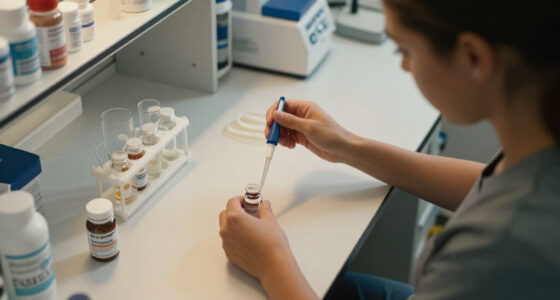

I understand that the H. pylori urea breath test works by having you swallow a special, labeled urea substance. If you have a H. pylori infection, the bacteria’s enzyme breaks down the urea, releasing labeled carbon dioxide that shows up in your breath. A positive result means active infection, while a negative indicates no current infection. If you’re curious about how this process *guarantees* accurate detection, keep exploring to learn more.
Listen free for 30 days with Audible
Thousands of audiobooks and originals — cancel anytime.
As an affiliate, we earn on qualifying purchases.
Key Takeaways
- The test detects active H. pylori infection by measuring labeled carbon dioxide in your breath after ingesting a special urea substance.
- Urease enzyme from H. pylori breaks down the labeled urea, releasing labeled carbon dioxide that is measured in breath samples.
- A positive result indicates the presence of active H. pylori infection, while a negative result suggests no current infection.
- Proper patient preparation, including fasting and avoiding certain medications, is essential for accurate results.
- The test is quick, non-invasive, highly accurate, and helps confirm infection or assess treatment success.

Have you ever wondered how doctors detect Helicobacter pylori infection without invasive procedures? The answer lies in the urea breath test, a simple, effective method that provides high diagnostic accuracy. This test works by analyzing your exhaled air after you ingest a special substance. When H. pylori is present in your stomach, it produces an enzyme called urease, which breaks down urea into carbon dioxide and ammonia. The urea breath test takes advantage of this reaction: if urease is present, your body releases labeled carbon dioxide into your breath, which can then be measured to confirm infection.
One of the reasons this test is so reliable is its high diagnostic accuracy. It’s known for accurately detecting active H. pylori infections, making it a preferred choice for both initial diagnosis and testing whether treatment has been successful. Unlike stool tests or blood antibody tests, the urea breath test detects current infection, not past exposure. That’s why it’s considered a gold standard in non-invasive testing for H. pylori.
The urea breath test offers high accuracy in detecting active H. pylori infections non-invasively.
However, to ensure the test’s accuracy, proper patient preparation is essential. Before the test, you’re typically advised to avoid certain medications, like antibiotics, proton pump inhibitors, and bismuth-containing drugs, for at least two weeks. These medications can suppress bacterial activity and interfere with the results. Additionally, fasting for about 6 hours before the test is usually recommended to prevent food and drink from affecting the measurement of exhaled carbon dioxide. It’s also important to inform your healthcare provider about any recent medications or health conditions, as they may need to adjust preparations accordingly.
During the test, you’ll be asked to breathe into a collection device after consuming a solution containing a labeled urea compound. If H. pylori is present, the bacteria’s urease enzyme will break down the urea, releasing labeled carbon dioxide that your lungs exhale. The device then measures the amount of labeled carbon dioxide in your breath, providing a quick, non-invasive indication of infection. The entire process is painless and takes about 15 to 20 minutes, making it a convenient choice for many patients. Advances in robotics technology are also contributing to improvements in diagnostic tools and medical testing procedures, enhancing the precision and efficiency of such tests.
As an affiliate, we earn on qualifying purchases.
Frequently Asked Questions
Can the Urea Breath Test Detect Other Bacteria Besides H. Pylori?
The urea breath test mainly detects H. pylori because of its high diagnostic specificity. While some alternative bacteria can produce similar enzymes, the test isn’t reliable for identifying other bacteria. I’d say it’s pretty specific for H. pylori, but it doesn’t effectively detect alternative bacteria. If other infections are suspected, your doctor might recommend additional tests for a more accurate diagnosis.
How Long Does It Take to Get Test Results?
Typically, I get my test results within 24 to 48 hours after the test. The result processing duration is pretty quick, as the lab analyzes the breath sample soon after it’s collected. However, sometimes it might take a bit longer if there are delays or high demand. I always check with my healthcare provider for the most accurate estimate on test result timing, so I know when to expect my results.
Are There Any Special Preparations Before the Test?
Before the test, I make sure to follow a few simple steps. I fast for at least six hours, avoiding food and drinks, to clear my stomach. I also check with my doctor about medication guidelines, as some medicines may affect results. This way, I prepare my body for accurate testing—like clearing a path for clear signals, ensuring that everything is set for reliable, precise results.
Can the Test Be Performed on Children?
Yes, the test can be performed on children, but pediatric considerations are important. I guarantee the testing procedures are gentle and appropriate for their age. Usually, kids can do the test if they understand instructions, but sometimes adjustments are needed. I work closely with parents to make sure the process is smooth and stress-free, so the results are accurate and reliable for diagnosing H. pylori infection in children.
What Are Common False-Positive or False-Negative Causes?
Did you know that false positives can occur in up to 10% of tests? I’ve seen false positives happen when recent antibiotics or proton pump inhibitors are used, which can suppress H. pylori and cause false negatives. Other causes include improper test timing or contamination. To get accurate results, I always recommend following pre-test instructions closely and informing your doctor about medications you’re taking.
Conclusion
Think of the H. pylori urea breath test as a detective’s magnifying glass, revealing hidden bacteria lurking in your stomach. It’s simple, quick, and gives you clear answers about your health. Whether you’re battling symptoms or just want peace of mind, this test guides you like a compass through your treatment journey. Remember, understanding what’s going on inside helps you take control and steer toward better health with confidence.
Flea & tick season Picks
flea and tick prevention
As an affiliate, we earn on qualifying purchases.