

Science shows that scent and pheromones influence attraction on a subconscious level by signaling genetic compatibility and good health. These chemical signals help our brains quickly identify potential mates who may produce healthy, diverse offspring. While cultural factors also shape how we perceive scents, the biological mechanisms behind pheromones serve as an evolutionary shortcut to enhance reproductive success. Curious about how these tiny signals truly impact your attraction? Keep exploring to uncover the fascinating details.

Get oils, diffusers and self-care delivered free — and shop member deals
- Fast, free delivery on millions of items
- Access to Prime Big Deal Days deals on October 6–7
- Prime Video, Amazon Music and more included
Key Takeaways
- Pheromones are chemical signals that influence subconscious attraction and communication between individuals.
- Scientific research indicates pheromones can subtly impact human attraction and mate selection.
- Scent cues provide evolutionary advantages by signaling genetic compatibility and health.
- Cultural factors, including societal norms and personal experiences, shape how scent influences attraction.
- The scientific consensus recognizes a complex interplay between pheromones, biology, and environment in human attraction.
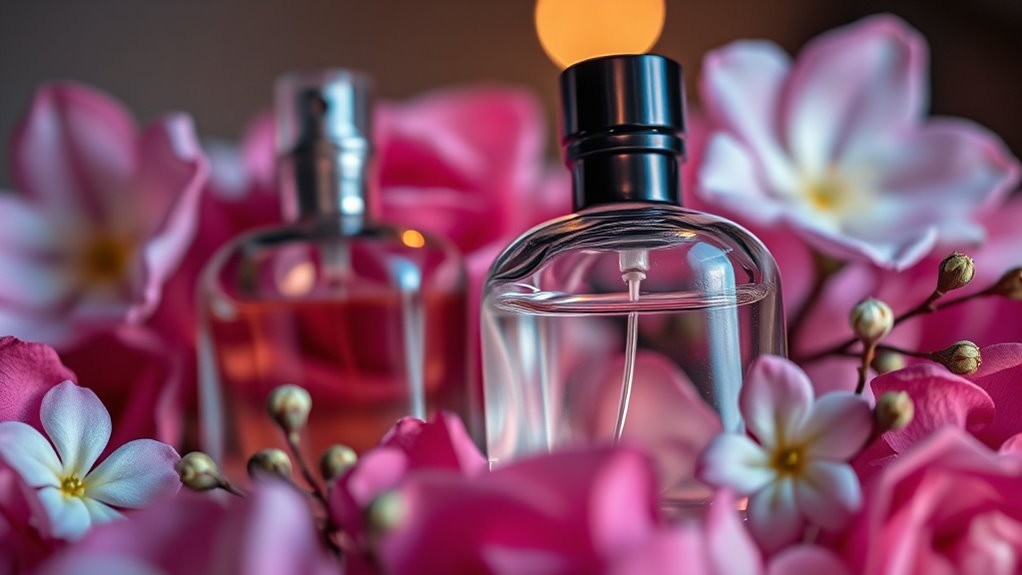
Have you ever wondered if there’s a biological shortcut to attraction beyond looks and words? It turns out, scent plays a surprisingly powerful role in how we connect with others, rooted deep in our biology and shaped by cultural influences. Pheromones—those chemical signals our bodies produce—are believed to influence subconscious attraction, tapping into ancient evolutionary advantages that helped our ancestors find compatible mates and ensure survival. These chemical messengers are thought to communicate information about genetic compatibility, health, and reproductive fitness, giving individuals an edge in choosing a partner who’s most likely to produce healthy offspring.
From an evolutionary perspective, the idea is simple: our ancestors who responded to subtle scent cues were more likely to select mates with desirable genetic traits, increasing the chances of healthy, viable children. Over generations, this biological mechanism became embedded in our subconscious, guiding us in ways we don’t even realize. It’s why some people find themselves inexplicably drawn to certain scents or pheromonal signals—they are, in a sense, connecting through a primal, evolutionary shortcut that bypasses conscious evaluation. These innate responses provided clear advantages in mate selection, helping to ensure genetic diversity and reproductive success.
Our subconscious response to scent cues boosts genetic diversity and reproductive success through primal, evolutionary shortcuts.
However, the influence of scent isn’t purely biological; it’s also heavily shaped by cultural influences. Society, media, and personal experiences all contribute to how we interpret and respond to scent cues. For example, certain fragrances or pheromone products are marketed as enhancing attraction, capitalizing on the idea that scent can influence subconscious preferences. Cultural norms also dictate what’s considered appealing or acceptable, shaping our individual responses to specific smells. A scent that might be attractive in one culture could be neutral or even repulsive in another, highlighting how deeply our perceptions of scent are intertwined with cultural context.
Despite ongoing scientific debate, many researchers agree that scent and pheromones do have a subtle but significant impact on attraction. They act as a biological shortcut, tapping into deep-seated evolutionary advantages that promote reproductive success. At the same time, cultural influences mold how we experience and interpret these signals, making attraction a complex dance between biology and environment. So, next time you catch a whiff of a scent that inexplicably draws you in, remember—there’s more beneath the surface than just a pleasant smell. It’s a fascinating blend of our evolutionary past and cultural present working together to shape human connection.
pheromone perfume for attraction
As an affiliate, we earn on qualifying purchases.
As an affiliate, we earn on qualifying purchases.
Frequently Asked Questions
Can Pheromones Influence Long-Term Relationship Success?
Yes, I believe pheromones can influence long-term relationship success. Chemical signaling through scent helps deepen emotional bonding by subconsciously reinforcing attraction and compatibility. When partners pick up on each other’s pheromones, it strengthens their connection and trust over time. While pheromones aren’t the only factor, I think they play a subtle but meaningful role in maintaining long-term intimacy and emotional closeness.
Are Pheromones Effective Without Conscious Scent Awareness?
Yes, pheromones can be effective without conscious scent awareness. I’ve read studies showing that our subconscious detects these chemical signals, influencing attraction even when we’re not aware of the scent. While we might not consciously notice pheromones, they still play a role in social and sexual interactions. So, even if you’re unaware of scent detection, pheromones could be subtly shaping your feelings and connections with others.
How Do Individual Genetics Affect Pheromone Perception?
Your genetics play a big role in how you perceive pheromones because of genetic variation affecting your scent sensitivity. I’ve noticed that some people are more attuned to subtle scents, making pheromones more impactful for them. These individual differences mean that pheromone effects aren’t universal; instead, your unique genetic makeup influences how strongly you respond to scent cues, shaping attraction and social interactions uniquely.
Do Pheromones Work the Same Across Different Genders?
Imagine a study showing women respond more strongly to certain pheromones than men do. Gender differences in scent perception mean pheromones don’t work exactly the same across genders. Men and women have different olfactory sensitivities and hormonal influences, affecting how they perceive and react to these chemical signals. So, while pheromones can influence attraction, their effects vary depending on gender, making the impact personalized rather than universal.
Can Synthetic Pheromones Replace Natural Scent Attraction?
Synthetic scent can mimic natural attraction, but it often falls short of the complex, subtle cues our natural scent provides. I believe natural attraction relies on authentic pheromones that our bodies produce, which are hard to replicate perfectly. While synthetic pheromones might enhance attraction, they can’t fully replace the nuanced signals of natural scent. Ultimately, genuine connection often depends more on chemistry than just a synthetic fragrance.
Conclusion
So, while pheromones might be tiny messengers dancing unseen, they’ve got a way of stirring something deep inside us. Like a subtle whisper in the wind, they can hint at connection and chemistry beyond what the eyes can see. Remember, attraction isn’t just about scent, but the symphony of signals we send and receive. Embrace the mystery, and let nature’s quiet language guide your heart’s secret conversations.
Fall Picks
fall essentials
As an affiliate, we earn on qualifying purchases.