
TL;DR

Get oils, diffusers and self-care delivered free with Prime
- Fast, free delivery on millions of items
- Prime Video, Amazon Music and more included
- Member-only deals all year
A Fit&Well report highlights muscular power—the ability to produce force quickly—as a fitness quality that can be overlooked in midlife, alongside strength. Trainer Kylie Hansen recommends adapted exercises that emphasize controlled, purposeful movement, but the report does not provide new research quantifying the effects of this workout on longevity.
Fit&Well has highlighted muscular power—the ability to produce force quickly—as a fitness quality women may overlook in midlife, and published a four-exercise routine recommended by trainer Kylie Hansen. Hansen says power can matter for quick responses such as catching oneself after a trip; the report offers expert guidance, not new evidence that the routine extends lifespan.
Hansen, a NASM-certified personal trainer and coach at Busy Bariatrics, defines power as using strength at speed. She says movements that require a quick response, including regaining balance after a stumble, rely on producing force promptly. The Fit&Well report says the muscle fibers involved in quick, powerful movements can decline with age and inactivity, attributing that explanation to Hansen.
The workout comprises burpees, squat jumps, squats to upright rows, and plank dumbbell pull-throughs. Hansen’s prescribed format is two or three sets of each exercise, generally five or six repetitions, with 60 to 90 seconds of rest between sets. For the pull-through, the recommendation is five or six repetitions per side. The report advises completing one exercise before moving to the next.
Hansen emphasizes crisp, purposeful repetitions rather than exhaustion, saying power falls as fatigue builds. The routine includes easier versions: step rather than jump during burpees, rise onto the toes instead of jumping for squat jumps, and do plank pull-throughs from the knees. The report does not offer individualized medical advice or say every exercise is suitable for every person.
Power for Quick Everyday Responses
Strength is widely discussed in advice about exercise and aging, while this report draws attention to a related but distinct quality: how quickly force can be produced. A person may be strong yet still need to practice moving quickly and coordinating that movement. Hansen connects power to everyday tasks that call for a fast response, such as steadying oneself after a trip.
The practical point is not that these four exercises have been shown to prevent falls or extend life. Rather, the report presents power training as one possible part of an exercise routine, with modifications that reduce impact or difficulty. The distinction matters to readers evaluating a workout: explosive movement is not the same as training to exhaustion, and the trainer recommends rest so each repetition can be performed with intent.
The headline frames power as important for longevity, but the supplied report does not cite a study testing this specific program or quantify a longevity benefit. Its evidence here is an expert’s explanation and exercise recommendations. Readers should treat the longevity framing as the report’s rationale, not as a demonstrated outcome from the routine.
As an affiliate, we earn on qualifying purchases.
How the Four-Move Routine Works
The workout combines three movements intended to develop power with a core stability exercise. Burpees coordinate the upper and lower body and can be stepped through or performed with a jump. Squat jumps focus on lower-body force; Hansen suggests rising onto the toes as a lower-impact alternative. The squat-to-upright-row combines standing from a squat with pulling weights toward the chest.
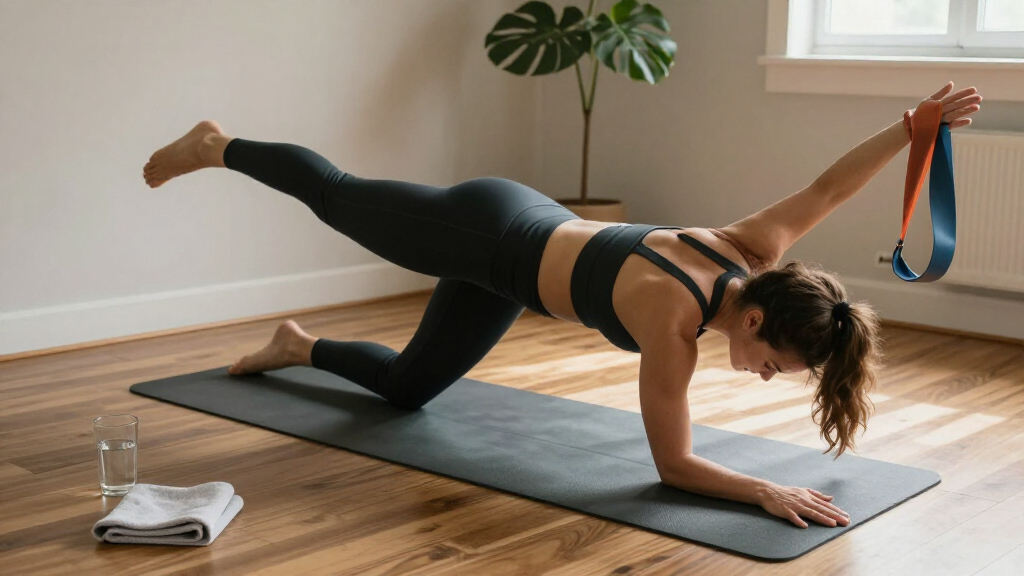
The plank dumbbell pull-through is different from the other three. From a high plank, a person moves a dumbbell from one side of the body to the other while trying to keep the hips steady. Hansen says the challenge is creating stability as the base of support changes. The report recommends a knees-down version for an easier variation.
Hansen’s programming guidance is consistent across the moves: two or three sets, five or six repetitions, and 60 to 90 seconds of rest. For pull-throughs, the repetition count applies to each side. She advises prioritizing movement quality over adding repetitions until fatigued. The source does not set out a weekly schedule or a progression plan for increasing difficulty.
“That means being able to use your strength at speed—a skill that matters when you need to catch yourself after a trip or move quickly to regain your balance.”
— Kylie Hansen
Evidence and Individual Suitability
The source material does not identify a publication date, cite research measuring this workout’s effects, or provide data on how much power typically changes in midlife. It also does not establish that completing the routine improves longevity, prevents falls, or produces a particular health outcome. Those claims should not be inferred from the trainer’s recommendations.
It is also unclear how readers should adapt the program for injuries, health conditions, limited exercise experience, or equipment access. The report supplies some movement modifications but does not offer individualized screening or coaching. People with existing health concerns, pain, or uncertainty about jumping and loaded exercises should seek guidance from a qualified health professional or trainer before attempting them.
Applying the Advice Safely
The report’s immediate guidance is to begin with a version suited to the person’s ability, use controlled movement, and rest between sets. A reader who is new to the exercises can use the stated modifications—such as stepping through a burpee or performing the plank pull-through from the knees—instead of starting with jumps. The source does not specify how often to repeat the workout or when to progress.
Any further claims about benefits would require evidence beyond the recommendations provided here, including research that measures outcomes over time. For now, the report offers a trainer’s practical routine and rationale; it does not establish a clinical or longevity result.
Key Questions
What does muscular power mean?
Muscular power is the ability to produce force quickly. Hansen describes it as using strength at speed, such as when making a rapid movement to regain balance.
Which exercises does the report recommend?
The four moves are burpees, squat jumps, squats to upright rows, and plank dumbbell pull-throughs. Hansen recommends two or three sets of each, usually five or six repetitions, with 60 to 90 seconds of rest between sets.
Can beginners modify the workout?
Yes. The report suggests stepping rather than jumping during burpees, rising onto the toes instead of jumping for the squat-jump movement, and doing the dumbbell pull-through from the knees. Hansen also advises using familiar movements and appropriate modifications.
Does the report prove power training extends lifespan?
No. The source presents a trainer’s explanation and exercise suggestions, but it does not cite evidence showing that this particular workout extends lifespan or prevents falls.
How should people approach the repetitions?
Hansen advises prioritizing controlled, purposeful repetitions over exercising to exhaustion, because she says power drops as fatigue builds. People with health concerns or uncertainty about the movements should consult a qualified professional before starting.
Source: rss
Halloween Picks
halloween
As an affiliate, we earn on qualifying purchases.