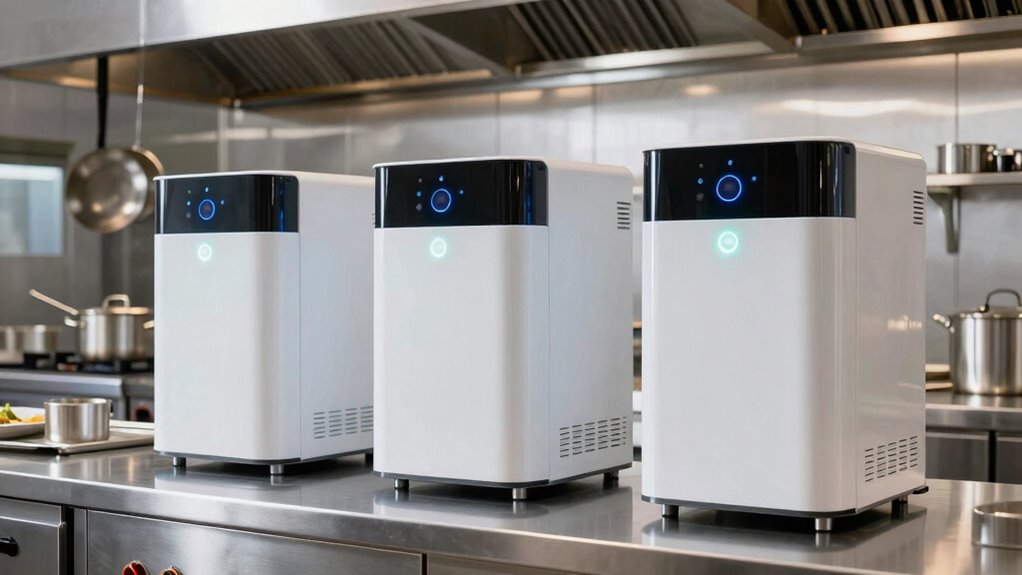

Choosing an air purifier for a restaurant kitchen means balancing particle filtration with airflow, odor reduction, and the realities of a busy room. My strongest pick for a large, open space is the Smart Air Blast, thanks to its stated 1,140 CFM airflow and activated carbon filter. For sensor-led operation in a smaller back-of-house area, I’d compare it with the Winix 5520, while the Blueair Signature SP1i is the quietest option listed for a compact room where sound matters.

Get oils, diffusers and self-care delivered free with Prime
- Fast, free delivery on millions of items
- Prime Video, Amazon Music and more included
- Member-only deals all year
These products are not substitutes for a commercial range hood or a properly designed exhaust system. Their room coverage figures also use different time frames, so I treat them as directional rather than directly interchangeable. The main tradeoff is clear: high airflow and carbon capacity matter more for a large, odor-prone room, while automatic controls and quieter operation can be more useful in a small dining-adjacent space. I ranked these picks by how well their stated features fit those restaurant-kitchen needs, while accounting for limitations such as filter replacement and coverage claims.
Complete the kit


Key Takeaways
- The Smart Air Blast is the strongest fit here for a large open kitchen because it lists 1,140 CFM airflow and combines H13 HEPA filtration with activated carbon.
- The Winix 5520 offers automatic fan adjustment, app compatibility, and carbon filtration, but its 1,882-square-foot figure is based on one hour of cleaning; its AHAM-verified coverage is 392 square feet.
- FreAire pairs a PM2.5 sensor and automatic mode with triple air intakes, but its HEPA filter is recommended for replacement every 3–6 months.
- The MOOKA PR1 has a washable pre-filter and six modes, including Pet and Auto, but the supplied information does not quantify its airflow or carbon capacity.
- The Blueair Signature SP1i is the quietest listed at 19 dB, but its stated rapid-cleaning room size is only 248 square feet, making it a compact-space pick rather than a whole-kitchen solution.
| Smart Air Blast Large-Room Air Purifier with H13 HEPA and Activated Carbon Filters |  | Best Overall for Large, Open Kitchens | Airflow: 1,140 CFM | Coverage claim: Up to 4,280 sq ft in 30 minutes | HEPA filtration: H13; captures 99.97% of particles ≥0.3 µm | VIEW ON AMAZON | See Our Full Breakdown |
| FreAire Air Purifier for Large Rooms up to 2,600 sq ft with HEPA Filter |  | Best for Sensor-Led Operation | Coverage claim: Up to 2,600 sq ft per hour | Filtration: HEPA filter; captures 99.97% of airborne particles | Air intakes: Triple intake | VIEW ON AMAZON | See Our Full Breakdown |
| MOOKA PR1 Air Purifier for Large Rooms, White |  | Best for Flexible Modes and Washable Pre-Filtration | Model and color: PR1, white | Coverage claim: Up to 2,200 sq ft | Filtration system: Four-stage | VIEW ON AMAZON | See Our Full Breakdown |
| Blueair Signature SP1i Air Purifier |  | Best Compact, Quiet Option | Model: Signature SP1i | Room coverage: Up to 248 sq ft per 12.5 minutes; up to 1,190 sq ft per hour | Filtration: 7-stage HEPASilent | VIEW ON AMAZON | See Our Full Breakdown |
| Winix 5520 Air Purifier for Large Rooms |  | Best for App-Connected Automatic Control | Model: 5520 | Room coverage: Up to 1,882 sq ft in 1 hour | AHAM-verified coverage: 392 sq ft | VIEW ON AMAZON | See Our Full Breakdown |
| air purifier for restaurant kitchen | Coverage claim | Noise | Filtration |
|---|---|---|---|
| Smart Air Blast Large-Room Air | Up to 4,280 sq ft in 30 minutes | Approximately 29 dBA on low; 43 dBA on high | — |
| FreAire Air Purifier for Large | Up to 2,600 sq ft per hour | — | HEPA filter; captures 99.97% of airborne particles |
| MOOKA PR1 Air Purifier for Lar | Up to 2,200 sq ft | — | — |
| Blueair Signature SP1i Air Pur | — | As low as 19 dB | 7-stage HEPASilent |
| Winix 5520 Air Purifier for La | — | 23.5 dB on lowest speed | Four-stage True HEPA, carbon filter, and washable fine-mesh pre-filter |
More Details on Our Top Picks
Smart Air Blast Large-Room Air Purifier with H13 HEPA and Activated Carbon Filters
The Smart Air Blast takes the lead because it is the only option here with a stated 1,140 CFM airflow. For an open back-of-house area, that makes its capacity easier to judge than a large square-foot figure alone. The supplied claim says it can clean up to 4,280 square feet in 30 minutes, though room layout, ceiling height, obstructions, and cooking activity can change real-world results. I would not use that coverage number as a promise for every kitchen.
Its combination of H13 HEPA and activated carbon is better aligned with a restaurant setting than particle filtration alone: HEPA addresses airborne particles, while carbon targets odors and gases. A washable pre-filter can catch larger dust and hair before they reach the main filter, potentially reducing some of the burden on it. Compared with the sensor-rich FreAire and Winix, though, the supplied description does not list automatic air-quality adjustment or app controls. This is a capacity-first choice, not the most automated one.
Noise is listed at approximately 29 dBA on low and 43 dBA on high. That gives a useful range, but a powerful unit running near high speed may be noticeable in a dining area. I’d place it where high airflow matters more than quiet conversation, and I’d confirm that the model and its filters suit the intended commercial environment. The available details do not establish grease handling, a commercial certification for kitchen exhaust use, or field performance in a restaurant.
Pros:- Stated 1,140 CFM airflow gives a clear capacity figure for comparison.
- H13 HEPA filtration is specified for particles at least 0.3 microns in size.
- Activated carbon targets odors and gases, unlike particle filtration alone.
- Washable pre-filter captures larger dust and hair.
Cons:- Large-room coverage claims may not match performance in every layout or operating condition.
- High-speed noise is listed at approximately 43 dBA, which may be distracting near diners.
- The supplied details do not describe sensor-based automatic adjustment or commercial kitchen certification.
Best for: Operators seeking a high-airflow supplemental purifier for a large, open kitchen or back-of-house area, with particle and odor filtration both specified.
Not ideal for: Buyers who need a compact, low-noise dining-room unit, app-based controls, or a purifier approved to replace commercial ventilation.
- Airflow:1,140 CFM
- Coverage claim:Up to 4,280 sq ft in 30 minutes
- HEPA filtration:H13; captures 99.97% of particles ≥0.3 µm
- Fine-particle detail:Down to 0.07 µm through diffusion
- Additional filters:Activated carbon and washable pre-filter
- Noise:Approximately 29 dBA on low; 43 dBA on high
Our verdict“I rank the Smart Air Blast first for large kitchens because its stated airflow and carbon-plus-HEPA setup offer the clearest fit for a high-volume supplemental purifier.”
FreAire Air Purifier for Large Rooms up to 2,600 sq ft with HEPA Filter
FreAire is the more control-focused alternative to the Smart Air Blast. Its triple air intakes, four fan speeds, and PM2.5 display are aimed at buyers who want a unit to respond to changing room conditions rather than simply run at a chosen speed. Auto mode can adjust the fan based on its sensor, which is convenient in a kitchen where activity and airborne particles vary across a service period. The listed coverage is up to 2,600 square feet per hour, a different measure from Smart Air’s 30-minute claim and not a direct performance comparison.
The washable pre-filter helps catch larger particles, and a filter reminder makes maintenance easier to track. Sleep mode is listed at 22 dB, but quiet-mode performance is less relevant when the purifier is working hard beside active cooking equipment. The HEPA filter is recommended for replacement every 3–6 months, and the manufacturer recommends official replacement filters. That recurring upkeep is a meaningful tradeoff for a restaurant that runs equipment for long shifts.
Compared with MOOKA, FreAire gives a clearer sensor-and-auto-control package; compared with Winix, it lists triple intakes but lacks the latter’s stated app compatibility. I’d choose it for a large room where monitoring and automatic fan changes matter. Its description identifies a HEPA filter for particles, but does not specify activated carbon for odor reduction, so it is less clearly suited to persistent cooking smells than Smart Air or Winix. The listed certifications are product claims, not evidence that it replaces a kitchen hood or meets every local installation requirement.
Pros:- Triple air intakes and four fan speeds offer multiple operating choices.
- PM2.5 monitoring and Auto mode support sensor-led fan adjustment.
- Washable pre-filter and filter replacement reminder simplify routine upkeep.
- Sleep mode is listed at 22 dB for quieter periods.
Cons:- HEPA filter replacement is recommended every 3–6 months.
- The manufacturer recommends official replacement filters.
- The supplied description does not specify carbon filtration for cooking odors.
Best for: A buyer who wants a large-room purifier with a PM2.5 display, auto mode, several fan speeds, and a washable pre-filter.
Not ideal for: Restaurants prioritizing specifically described carbon odor filtration, infrequent filter replacement, or app control.
- Coverage claim:Up to 2,600 sq ft per hour
- Filtration:HEPA filter; captures 99.97% of airborne particles
- Air intakes:Triple intake
- Air-quality sensor:PM2.5
- Fan settings:4 speeds, Auto mode, and Sleep mode
- Sleep noise:22 dB
- Pre-filter and replacement:Washable pre-filter; HEPA replacement recommended every 3–6 months
- Listed certifications:ETL, FCC, EPA, CARB, DOE
Our verdict“I’d choose FreAire over the less automated MOOKA when PM2.5 monitoring and automatic adjustment matter more than a stated odor-control filter.”
MOOKA PR1 Air Purifier for Large Rooms, White
The MOOKA PR1 is a flexible mid-sized pick for a restaurant that wants multiple ways to run a purifier without relying on app controls. Its six fan modes include Auto, Pet, and Sleep, and the washable pre-filter can collect larger debris before it reaches the rest of the four-stage system. The PM2.5 display offers a visible air-quality reading. Those features make it easier to adapt settings through the day than a basic fixed-speed unit, though the Pet mode label does not mean it is designed specifically for cooking emissions.
MOOKA lists coverage up to 2,200 square feet, but the supplied information gives no airflow figure or cleaning time for that area. That makes its capacity harder to compare with Smart Air’s CFM or with the time-based claims from FreAire and Winix. It also lists a four-stage filtration system, but the description does not detail the carbon stage’s quantity or odor performance. For strong cooking smells, I’d favor the clearly described activated carbon in Smart Air or Winix rather than assume the PR1 will handle them equally well.
Sleep mode is rated as low as 26 dB, which is quieter than the stated low-speed noise for Smart Air, though not as quiet as Blueair’s 19 dB. The filter replacement recommendation is every 3–6 months, and the PM2.5 indicator flashes during a one-minute startup preheating period. That brief behavior may puzzle staff if they expect a steady reading immediately. I see this as a practical choice for a smaller prep or support area where mode flexibility and a washable pre-filter matter more than documented high airflow.
Pros:- Six modes include Auto, Pet, and Sleep for different operating needs.
- Washable pre-filter captures larger debris and can be cleaned for reuse.
- PM2.5 display and filter reminder help with monitoring and routine maintenance.
- Sleep mode is listed as low as 26 dB.
Cons:- No airflow figure or coverage cleaning time is provided for direct capacity comparison.
- Replacement filters are recommended every 3–6 months.
- Air-quality indicator flashes during a one-minute startup preheating period.
Best for: A small restaurant or prep-room operator who values a washable pre-filter, PM2.5 display, and several built-in modes.
Not ideal for: A large kitchen needing published CFM, clearly quantified odor-control capacity, or longer stated filter intervals.
- Model and color:PR1, white
- Coverage claim:Up to 2,200 sq ft
- Filtration system:Four-stage
- Pre-filter:Washable
- Fan modes:Sleep, I, II, III, Auto, and Pet
- Sleep noise:As low as 26 dB
- Monitoring and controls:PM2.5 display, timer, child lock, aroma function, filter reminder
- Filter replacement:Recommended every 3–6 months
Our verdict“MOOKA makes most sense for a secondary room that needs flexible controls and washable pre-filtration, not as my first choice for a demanding cooking line.”
Blueair Signature SP1i Air Purifier
The Blueair Signature SP1i is the clear compact-space specialist in this lineup. It is rated to clean up to 248 square feet in 12.5 minutes and up to 1,190 square feet per hour, figures that position it well below Smart Air for a large open kitchen. Its advantage is quieter operation: the stated minimum is 19 dB, the lowest noise figure among these five products. For a small dining-adjacent prep area or a quiet service zone, that difference may matter more than maximum air movement.
Blueair’s seven-stage HEPASilent system is listed as capturing 99.97% of particles down to 0.1 microns, and OdorFence Technology is described as helping reduce odors, gases, and VOCs. That gives it a more explicit odor-control claim than MOOKA or FreAire. It also includes app controls, Auto mode, and a five-color air-quality indicator. Compared with Winix, it provides a lower stated noise level and an odor technology name, but Winix’s coverage claims are more expansive—though they, too, require attention to the stated cleaning time.
The main limitation is scale: a restaurant should not mistake the 1,190-square-foot-per-hour figure for high-speed cleaning across a busy, full-size kitchen. The interchangeable pre-filters are available separately, adding another upkeep consideration. I would use the SP1i as a targeted unit for a small room or quieter area, not as the main response to a smoky line or a large open-plan kitchen. As with the other products here, it is supplemental air cleaning rather than source-capture ventilation.
Pros:- Quiet operation is listed as low as 19 dB.
- Seven-stage HEPASilent filtration is specified to capture 99.97% down to 0.1 microns.
- OdorFence Technology is described as reducing odors, gases, and VOCs.
- App controls, Auto mode, and a five-color air-quality indicator are included.
Cons:- The 248-square-foot rapid-cleaning claim makes it a compact-room choice, not a large-kitchen leader.
- Interchangeable pre-filters are available separately.
- The listed coverage measures should not be read as equivalent to Smart Air’s CFM specification.
Best for: Operators seeking a quiet purifier for a compact prep room or dining-adjacent area, with app controls and stated odor reduction.
Not ideal for: A buyer who needs the highest airflow, a single unit for a large cooking line, or included interchangeable pre-filters.
- Model:Signature SP1i
- Room coverage:Up to 248 sq ft per 12.5 minutes; up to 1,190 sq ft per hour
- Filtration:7-stage HEPASilent
- Particle capture:99.97% down to 0.1 microns
- Odor control:OdorFence Technology
- Noise:As low as 19 dB
- Controls:Blueair app and Auto mode
- Air-quality indicator:Five colors
Our verdict“I’d pick Blueair for quiet, targeted air cleaning in a small space, while choosing Smart Air or FreAire when kitchen area and airflow take priority.”
Winix 5520 Air Purifier for Large Rooms
The Winix 5520 suits an operator who wants a purifier to adjust itself as room conditions change. Its air-quality sensing can drive automatic fan adjustment, and the unit supports the Winix Smart App as well as automatic Sleep Mode. Those controls make it more convenient than the capacity-first Smart Air Blast for someone who wants to monitor operation remotely or leave fan changes to Auto mode. Its four-stage system includes True HEPA, carbon filtration, and a washable fine-mesh pre-filter, giving it a useful mix of particle and odor-related features.
Coverage needs careful reading. Winix states up to 1,882 square feet in one hour, while its AHAM-verified coverage is 392 square feet. Those figures describe different bases and should not be collapsed into one simple large-room promise. For a busy restaurant kitchen, that distinction makes the 5520 a better fit for a smaller zone or supplemental placement than for treating a large open kitchen with a single unit. Smart Air is the stronger high-airflow choice, and FreAire gives a larger stated per-hour coverage figure, though neither comparison removes the need to match purifier capacity to the actual room.
The listed particle-capture claim is 99.99% of airborne allergens as small as 0.01 microns, and the lowest speed is rated at 23.5 dB. That quieter setting may help in a nearby customer area, but it does not tell me how loud the unit becomes at the speeds needed during heavy cooking. I’d shortlist Winix for app-connected control and its combination of HEPA and carbon filtration, while keeping the verified coverage and source-capture limits in mind.
Pros:- Air-quality sensing can adjust fan speed automatically.
- Four-stage filtration includes True HEPA, carbon, and a washable fine-mesh pre-filter.
- Winix Smart App compatibility and automatic Sleep Mode add control options.
- Lowest-speed noise is listed at 23.5 dB.
Cons:- The 1,882-square-foot coverage claim is based on one hour of cleaning.
- AHAM-verified coverage is 392 square feet, a much smaller figure to note when sizing a room.
- The supplied information does not state the amount of carbon media or odor reduction rate.
Best for: A buyer who wants app compatibility, automatic fan adjustment, and carbon-plus-HEPA filtration for a smaller or supplemental area.
Not ideal for: Operators seeking a clearly high-CFM main purifier for a large kitchen or relying on the 1,882-square-foot figure without noting its one-hour basis.
- Model:5520
- Room coverage:Up to 1,882 sq ft in 1 hour
- AHAM-verified coverage:392 sq ft
- Filtration:Four-stage True HEPA, carbon filter, and washable fine-mesh pre-filter
- Particle capture claim:99.99% of airborne allergens as small as 0.01 microns
- Noise:23.5 dB on lowest speed
- Controls:Auto Mode, automatic Sleep Mode, and Winix Smart App compatibility
- Certifications:AHAM Verified and UL Certified
Our verdict“Winix is my pick for app-connected automation in a smaller zone, but I would not rank it ahead of Smart Air for a large kitchen needing clearly stated high airflow.”

How We Picked
I ranked these five units by their fit for the specific challenges of a restaurant kitchen: moving enough air for the intended space, filtering airborne particles, addressing odors where carbon filtration is specified, and operating with manageable noise and upkeep. A purifier can help reduce particles and some odors in room air, but it does not capture cooking emissions at their source. I do not treat any of these as a replacement for a commercial hood, grease-rated exhaust, or ventilation designed to meet local codes.
Airflow and coverage claims received close attention, but the numbers are not presented on a single basis. Smart Air provides CFM and a 30-minute coverage claim; FreAire gives coverage per hour; Winix lists both a one-hour coverage claim and AHAM-verified coverage; Blueair states a room size per 12.5 minutes and per hour. I report those claims as supplied and avoid treating them as direct equivalents. I also considered how clearly each listing describes odor control, washable pre-filters, sensors, fan settings, and replacement intervals.
My ranking rewards practical fit, not the longest feature list. The Smart Air Blast leads for a large room because its stated airflow is the clearest high-capacity figure in this group. FreAire follows for broad coverage paired with monitoring and automatic adjustment. MOOKA earns a flexible, maintenance-conscious role, while Winix stands out for app-connected sensing but has a more modest AHAM-verified area. Blueair ranks as a compact, quiet choice rather than a primary purifier for a large, hot cooking line. Product information supplied for this comparison does not establish performance under grease-heavy commercial conditions, so I keep that limitation in view.
| air purifier for restaurant kitchen | Coverage claim |
|---|---|
| Smart Air Blast Large-Room Air | Up to 4,280 sq ft in 30 minutes |
| FreAire Air Purifier for Large | Up to 2,600 sq ft per hour |
| MOOKA PR1 Air Purifier for Lar | Up to 2,200 sq ft |
| Blueair Signature SP1i Air Pur | — |
| Winix 5520 Air Purifier for La | — |
Factors to Consider When Choosing Air Purifier For Restaurant Kitchen
I would select a restaurant-kitchen purifier only after separating source capture from room-air cleaning. The products here are portable room purifiers; none is described as a commercial range hood or grease-exhaust system. Use the comparison below to match a unit to a defined zone and operating need, rather than expecting one appliance to resolve all cooking emissions.
Treat ventilation as the first line of control
Cooking produces heat, moisture, grease, and airborne emissions at the point of use. A hood and exhaust system designed for the appliances and local requirements captures those emissions close to their source; a portable purifier recirculates room air after particles and some gases have spread. I would keep those roles separate in any purchasing plan. Check with a qualified kitchen-ventilation professional or local authority before changing a commercial exhaust setup, and do not use a portable purifier as a substitute for required ventilation.
Compare coverage claims on the same basis
Large square-foot numbers can hide important differences in test conditions. Smart Air gives a 30-minute coverage claim and a CFM figure, FreAire and Winix provide per-hour claims, and Blueair lists both a short cleaning interval and an hourly area. Winix also supplies an AHAM-verified area of 392 square feet alongside its larger one-hour claim. I would compare the cleaning time, room size, ceiling height, and airflow method rather than sorting by the biggest number. For a restaurant with partitions or a long narrow kitchen, a single large rating may not describe how evenly air circulates.
Match filtration to particles and odors
HEPA filtration targets airborne particles; it does not automatically mean strong odor removal. Carbon is the relevant feature when a product specifically describes filtration for odors or gases, as Smart Air and Winix do, while Blueair lists OdorFence Technology for odors, gases, and VOCs. The supplied descriptions do not quantify carbon mass or odor reduction rates, so I would not assume equal performance across those models. Also check how the manufacturer describes filters and intended use, especially where the purifier may sit near cooking activity.
Plan for filter care and running conditions
Washable pre-filters on Smart Air, FreAire, MOOKA, and Winix can catch larger debris and may reduce how quickly the main filter collects it, but they still need regular cleaning. FreAire and MOOKA recommend main-filter replacement every 3–6 months; filter needs depend on use and conditions, so follow the product instructions rather than assuming a calendar interval fits every restaurant. Ask about replacement-filter availability and cost before selecting a unit, without relying on one-time purchase figures alone. A purifier placed where grease or moisture can reach its intake may need more frequent attention than one in a cleaner adjacent zone.
Choose controls and noise for the room
Auto modes and PM2.5 displays can reduce manual fan changes, as seen on FreAire, MOOKA, and Winix. Sensors, however, only respond to what they detect near the unit and do not replace staff judgment about cooking conditions. For quiet areas, Blueair lists 19 dB at its quietest and Winix 23.5 dB on its lowest speed; these figures do not describe noise at maximum output. If conversation or customer comfort matters, prioritize placement and test the operating speed in the actual room before making the purifier a permanent fixture.
Size for a defined zone, not the whole business
A restaurant may need different solutions for the cooking line, prep room, dish area, and dining room. I would identify the specific zone, its floor area and ceiling height, how doors and partitions affect circulation, and whether the unit can be placed with clear intake and outlet space. Smart Air is the strongest listed candidate for a large open zone based on its CFM figure; Blueair is better suited to a compact, quiet area. For a large or complex kitchen, more than one appropriately placed unit may be more practical than expecting a single portable purifier to clean every area evenly.
Frequently Asked Questions
Can an air purifier replace a restaurant kitchen range hood?
No. These products are described as room air purifiers, not commercial grease-exhaust or source-capture systems. A range hood and ventilation system are designed to capture cooking emissions where they form, while a portable purifier treats air that circulates through its filters. I would keep required kitchen ventilation in place and check local codes and equipment requirements with a qualified professional.
Which model is the strongest fit for a large restaurant kitchen?
Among these five, the Smart Air Blast is my strongest large-room candidate because it lists 1,140 CFM and combines H13 HEPA with activated carbon. Its claim of up to 4,280 square feet in 30 minutes still depends on room conditions and should not be treated as guaranteed performance in every kitchen. For a large or divided space, compare measured airflow, room layout, and ventilation needs before relying on one portable unit.
Which options specifically describe odor control?
Smart Air specifies an activated carbon filter for odors and gases, Winix lists carbon filtration, and Blueair describes OdorFence Technology for odors, gases, and VOCs. The product information does not provide comparable carbon quantities or odor-reduction test results, so I would not assume these systems perform equally. FreAire and MOOKA descriptions focus on particle filtration and other features without giving the same explicit odor-control detail.
How should I interpret the large coverage numbers?
Check the time attached to each number and whether another verification figure is supplied. Smart Air gives a 30-minute claim, FreAire and Winix list per-hour coverage, and Blueair provides both a 12.5-minute room claim and an hourly figure. Winix also lists AHAM-verified coverage of 392 square feet, separate from its 1,882-square-foot one-hour claim. Those measurements are not interchangeable; room layout, ceiling height, placement, and operating speed affect the result.
How often will I need to maintain or replace filters?
Follow the instructions for the specific model and monitor filters more closely in a busy kitchen, where airborne debris may build up faster than in a typical living space. FreAire and MOOKA recommend main-filter replacement every 3–6 months, while the supplied information for the other products does not give a comparable replacement interval. Washable pre-filters should be cleaned as directed, and I would confirm replacement-filter availability before choosing any unit for continuous restaurant use.
Conclusion
For a large, open kitchen where airflow is the deciding factor, I would start with the Smart Air Blast, while treating its coverage claim as room-dependent and keeping commercial exhaust in place. For automatic monitoring and fan control, FreAire offers PM2.5 sensing and triple intakes; Winix is the better match when app compatibility and carbon filtration are priorities, provided its smaller AHAM-verified area fits the intended zone. MOOKA makes sense for a secondary prep area that benefits from multiple modes and a washable pre-filter. Choose Blueair for a compact, quiet space, not as the main cleaner for a busy cooking line. My final choice would depend on the defined room, the airflow and odor needs, and a realistic plan for filter care—not on a coverage number alone.
Halloween Picks
halloween
As an affiliate, we earn on qualifying purchases.