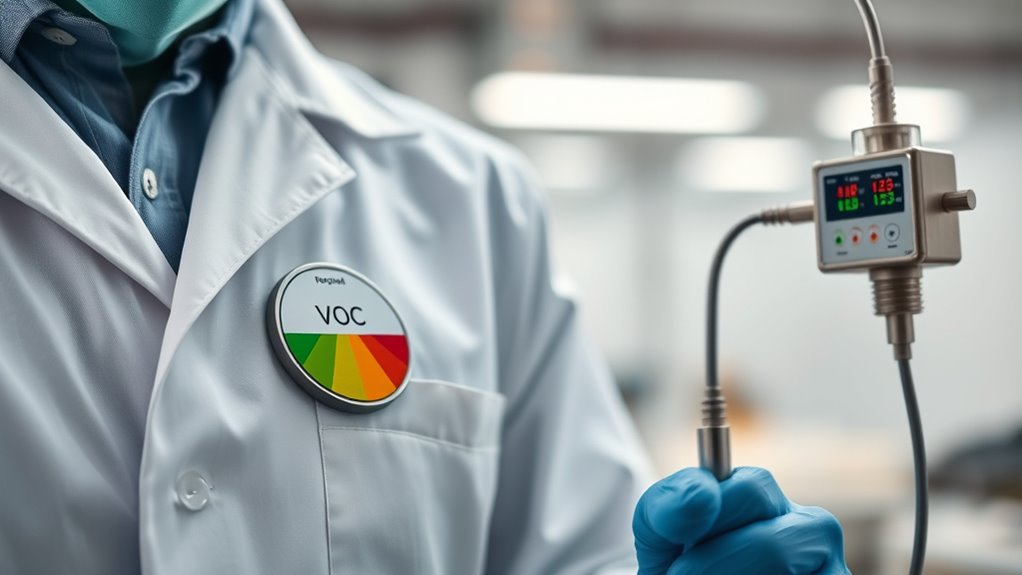

Occupational exposure monitoring involves using tools like VOC badges and air sampling to assess worker safety. VOC badges are passive devices worn during shifts, collecting airborne contaminants for lab analysis, while air sampling can be active, using pumps for precise measurement. Choosing the right method depends on your environment and chemicals involved. Proper application helps identify hazards early, ensuring compliance and safety. Keep exploring to discover more about how these techniques protect workers and create safer workplaces.
Key Takeaways
- VOC badges are passive samplers worn during work shifts to collect airborne volatile organic compounds for exposure assessment.
- Active air sampling uses pumps and sorbent tubes for precise measurement of VOC concentrations in occupational environments.
- Proper selection, calibration, and handling of sampling methods ensure accurate detection and compliance with safety regulations.
- Monitoring with VOC badges and air sampling helps identify hazards, implement controls, and protect worker health.
- Both techniques complement each other for comprehensive occupational exposure assessment and regulatory compliance.

Occupational exposure monitoring is essential for ensuring worker safety and complying with regulatory standards. When it comes to monitoring airborne contaminants, chemical detection plays a vital role in identifying hazardous substances that workers may encounter daily. One of the most effective ways to assess exposure is through the use of personal monitoring devices, such as VOC badges, and air sampling techniques that give us a clear picture of the concentration of hazardous chemicals in a workspace. These tools help us determine if exposure levels stay within safe limits and allow us to implement necessary controls if they don’t.
VOC badges are small, passive samplers that workers can wear during their shifts. They function by adsorbing volatile organic compounds from the air, giving us a snapshot of chemical exposure over a specific period. The simplicity of VOC badges makes them convenient for routine monitoring without disrupting daily activities. Once worn, these badges are sent to laboratories for analysis, where advanced chemical detection methods identify and quantify the VOCs collected. This process provides crucial data to evaluate whether exposure levels are safe or if additional protective measures are needed.
VOC badges are simple, passive devices that monitor airborne VOCs during work shifts.
Sampling techniques are equally important in occupational exposure monitoring. Active air sampling involves using pumps and sorbent tubes or filters to actively pull air through a collection medium, capturing specific contaminants efficiently. This method offers precise control over sampling flow rates and duration, which is critical when measuring low-level exposures or conducting detailed assessments. Passive sampling, on the other hand, relies on diffusion and requires less equipment, making it ideal for long-term monitoring or in hard-to-reach areas. Both techniques depend heavily on proper selection of sampling media and understanding the properties of the chemicals involved, ensuring accurate detection and quantification.
The choice of sampling technique often depends on the specifics of the environment and the chemicals in question. For example, in a manufacturing setting with high concentrations of VOCs, active sampling provides the accuracy needed for compliance and risk assessment. Conversely, passive sampling might be more suitable for screening or routine checks where long-term trends are of interest. Regardless of the method, proper calibration, sampling duration, and handling are critical to obtaining reliable data. This data then informs safety protocols, engineering controls, and personal protective equipment requirements.
In the end, effective occupational exposure monitoring hinges on a good understanding of chemical detection and sampling techniques. These tools enable us to proactively identify hazards, protect workers, and meet regulatory standards. By choosing the right method for each situation, we ensure that our workplaces remain safe and health-conscious environments. Additionally, staying informed about VOC detection methods can significantly improve the accuracy and reliability of exposure assessments.
Frequently Asked Questions
How Often Should VOC Badges Be Replaced During Monitoring?
I typically recommend replacing VOC badges every 8 to 24 hours, depending on badge longevity and the specific exposure situation. Shorter durations guarantee more accurate readings of airborne VOC levels, especially in high-risk environments. Always follow the manufacturer’s guidelines for replacement frequency, and consider the work environment’s VOC concentration to determine the best interval. Regular replacement helps maintain reliable monitoring results and keeps workers safe.
What Are the Limitations of Air Sampling in VOC Detection?
They say, “Don’t judge a book by its cover,” but air sampling has its limits. It can be affected by sampling variability, which means results might not always be consistent, and detection sensitivity, which could miss low-level VOCs. These factors make it challenging to get a complete picture of exposure, especially if conditions change rapidly or VOC levels fluctuate. So, I always recommend combining methods for better accuracy.
Can Personal Exposure Data Be Used for Legal Compliance?
Personal exposure data can be used for legal compliance, but I always consider the legal implications and data accuracy first. In many cases, this data supports compliance efforts, but it’s vital to guarantee it’s reliable and properly documented. If the data isn’t accurate or collected correctly, it could lead to legal issues. So, I recommend using validated methods and maintaining thorough records to confidently demonstrate compliance.
Are VOC Badges Suitable for All Industrial Environments?
Like a well-tailored suit, VOC badges aren’t suitable for all industrial environments. Material limitations and badge calibration affect their effectiveness, especially in high-temperature, highly humid, or chemically aggressive settings. I recommend evaluating each environment carefully before deployment, ensuring badges are properly calibrated and suited to specific conditions. Otherwise, you risk missing critical exposure data, much like trying to fit a square peg in a round hole.
How Do Ambient Conditions Affect Air Sampling Accuracy?
Ambient conditions greatly impact air sampling accuracy because environmental variables like temperature, humidity, and airflow can alter sample collection and VOC concentrations. I’ve faced calibration challenges when these variables fluctuate unexpectedly, making it harder to get precise readings. To guarantee reliable results, I always monitor environmental factors closely and recalibrate equipment regularly, understanding that stable ambient conditions are key to accurate air sampling.
Conclusion
In wrapping up, think of occupational exposure monitoring as your safety compass in a maze of chemicals. VOC badges and air sampling are your trusted guides, illuminating hidden dangers and keeping you one step ahead. By staying vigilant and using these tools, you’re not just protecting yourself—you’re steering your safety ship through turbulent waters to calmer, healthier shores. Remember, knowledge is your lighthouse in the storm—let it shine brightly.